First Stamp of Tasmania Van Diemen’s Land 1853
The first adhesive postage stamps of Tasmania hold a prestigious place in early postal history. Issued while the colony was still officially known as Van Diemen’s Land, these stamps offer a fascinating glimpse into the primitive, yet resourceful, printing methods of the mid-19th century.
The 1853 Postal Act and Launch A public notice published in the Hobart Town Gazette on September 27, 1853, announced that a new Post Office Act would come into operation on November 1 of that year. From that date forward, the prepayment of all letters and packets (excluding newspapers) posted within the colony was made compulsory and had to be paid using adhesive stamps. The stamps were made available in two denominations: One Penny (1d) and Fourpence (4d).
Design and Local Production Because the young colony lacked sophisticated, mass-production printing technology, the stamps were manufactured entirely in Hobart.
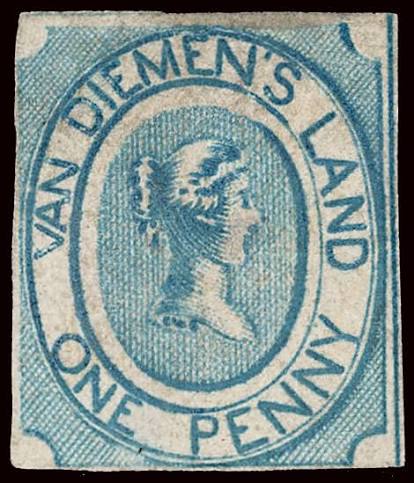
- Design: Both stamps featured a profile portrait of Queen Victoria facing to the right. The 1d value was printed in blue and light blue, while the 4d value was printed in shades of bright orange, orange-yellow, and orange-red.
- The Engraver: The dies were engraved in taille-douce (intaglio) on copper plates by C. W. Coard. A fascinating hidden detail is that the engraver’s initials, “C. W. Coard”, can be found on the cut of the Queen’s neck on the stamps, and his name was included in the marginal imprint along the bottom of the sheets.
- The Printers: The printing contract was awarded to Messrs. H. & C. Best (sometimes noted as A. & C. Best).
Varieties and “Plating” One of the most appealing aspects of the 1853 issue for modern philatelists is that the stamps were individually hand-engraved onto the plates. Each plate contained 24 stamps, arranged in four rows of six. Because every single stamp was engraved separately by hand, there are 24 distinct varieties or “types” for each value, resulting in minute differences in every stamp on the sheet.
While only one plate was created for the 1d blue, the 4d orange required two distinct plates. Historical invoices from H. & C. Best dated September 1853 show a charge of £36 for engraving the first 4d plate (at 30s per head) and £30 for “re-engraving” a second plate (at 25s per head). The exact chronological order and lifespan of these two 4d plates have been the subject of extensive study and plate-reconstruction by renowned philatelists.
Paper and Perforation The first issues were printed on white wove paper that varied wildly in thickness, with some stamps printed on a paper so thin it was almost transparent (“pelure”). A legendary rarity from this era is the 4d red-orange from Plate II printed on laid paper; a complete, immaculate sheet of 24 of these laid-paper stamps miraculously survived for decades hanging in a frame in a bungalow in India. All stamps of this 1853 issue were issued imperforate, meaning they had to be cut apart with scissors, and they bore no watermark.
The Mystery of the Triangular Punch A curious anomaly found on some surviving 1853 Van Diemen’s Land stamps is a deliberate triangular hole punched into the paper. Because no official postal records mention this mutilation, it has given rise to a few theories:
- The Convict Theory: One tradition suggests the stamps were punched before being issued to convict postmasters in remote, small country towns, rendering them useless as currency to prevent illicit trading.
- The Anti-Theft Theory: A more likely explanation is that the punch was applied privately by certain firms or postmasters as a security measure—acting as a check to prevent clerks and servants from stealing the stamps for their own personal use, much like the modern practice of punching company initials (perfins) into stamps.
Despite their primitive, crude appearance—or perhaps because of it—the 1853 Van Diemen’s Land stamps remain some of the most historic and highly prized classics of Australian philately