1857 Swan Issue Western Australia State Stamp Pre-Federation Australia
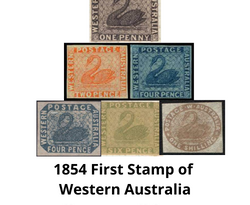
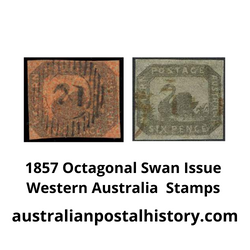
While some early stamp catalogues and collectors historically dated the first Western Australian stamps to 1855 or 1857—with auction records frequently listing the 2d brown-on-red and 6d bronze values specifically as “1857” issues—comprehensive philatelic research later proved that the colony’s true first postage stamps were issued on August 1, 1854. These pioneering stamps, featuring the elegant Black Swan, are among the most fascinating and highly prized classics of the philatelic world.
The Mandate of the Swan The design of Western Australia’s first stamps was strictly dictated by law. An 1854 ordinance explicitly required that the lawful stamp “shall represent the figure of a Swan, on a black or other ground”. This was a highly appropriate choice, as the indigenous black swan was the recognized emblem of the colony, which was originally known as the Swan River Settlement. Because this ordinance was never rescinded by the Legislative Council, the swan remained a mandatory feature on the colony’s postage stamps for decades.
London Engraving vs. Local Lithography The production of the first issue was split between London and the colony itself. In August 1853, the renowned London firm of Perkins, Bacon & Co. dispatched a consignment of 1,000,000 One Penny black stamps to Western Australia, along with a printing press, black ink, and special paper watermarked with the image of a swan.
However, the higher values—the 2d, 4d, 6d, and 1s—were produced locally in Perth to meet the colony’s postal needs. These were lithographed on the imported swan-watermarked paper, likely in the Surveyor-General’s Department by Horace Samson or his successor, A. Hillman. The local production method was crude but ingenious: workmen took lithographic transfers from the finely engraved London 1d plate, cut away the original borders, and pasted new, locally engraved frames around the central swan design. For example, the 4d received an octagonal frame, while the 1s received a transverse oval frame.
The World-Famous “Inverted Swan” Error This cut-and-paste method of local lithography resulted in one of the greatest rarities in the entire philatelic world: the 4d blue “Inverted Swan”. Because the workmen had to manually paste the newly engraved octagonal borders around the transferred central swan vignettes, a mistake was made on one of the impressions. The frame was accidentally pasted upside down relative to the center. Consequently, philatelic experts point out that the famous error is much more accurately described as an “inverted frame” rather than an inverted swan. This error is exceptionally rare, with only about eight or nine used copies known to exist. When a pristine copy surfaced at auction in 1904, it realized the then-astounding record price of £400.
The True Nature of the Error Despite its popular name, philatelic experts have proven that the swan itself is not inverted; rather, it is the frame around it that is upside down.
Because the colony lacked advanced printing capabilities, these higher-value stamps were produced locally using a primitive cut-and-paste lithographic method. Workmen took transfers of the central swan vignette from the finely engraved London 1d plate, cut away the original borders, and pasted these central designs onto a sheet at equal distances. Next, they took transfers of a newly engraved octagonal frame and manually pasted them around the central swan designs. During this painstaking assembly, a workman accidentally pasted the octagonal frame upside down on one of the impressions. Because the lettering on the border was small, this orientation mistake was much easier to overlook than if the prominent central swan had been placed upside down.
Position and Production The stamps were initially laid out in a matrix of 60 subjects (twelve horizontal rows of five), and the error is believed to have been located on the first stamp of the eighth row. To make a complete printing sheet of 240 stamps, this block of 60 was transferred to the lithographic stone four times. Therefore, there would have theoretically been four “inverted frames” on the complete initial sheet.
The error is found specifically in a dull blue shade, indicating that it belonged exclusively to the very first printing. The mistake was eventually discovered and corrected on the printing stone, meaning the inverted frame did not appear on any of the later printings.
Extreme Rarity and Value Because the error was corrected so early in the stamp’s production life, it remains one of the scarcest stamps in the world. There are only about eight or nine copies known to exist, all of which are in a used condition. Due to its legendary status, it has historically commanded immense value; for example, a pristine copy with uncut angles and a clear cancellation realized an astounding record price of £400 at a 1904 auction—the highest price ever paid for an Australian stamp at that time
The “Convict” Stamp Myth Another fascinating aspect of early Western Australian stamps is the presence of a deliberate circular hole punched through the center of some surviving specimens. In the early days of stamp collecting, a popular superstition circulated that these mutilated stamps were supplied to convicts serving their sentences in the colony, so their outgoing letters could be easily monitored and tracked. However, this romanticized myth was later debunked; the stamps were actually “Commissariat” stamps. The Imperial (British) Government purchased them from the local colonial post office and punched the holes as a security measure to prevent theft, using them exclusively to frank official correspondence for the Convict and Military Departments.
Through their blend of exquisite London engraving, primitive local lithography, legendary printing errors, and colorful postal history, the first Swan issues of Western Australia remain a cornerstone of classical philately.